Online Discovery

Why Your Restaurant Needs a Custom Website (Not Just a Template)

For food businesses that want full ownership of their brand, their customer data, and the ordering experience guests actually see

Katie Carswell

Katie Carswell

Account & Social Media Manager

7 min read
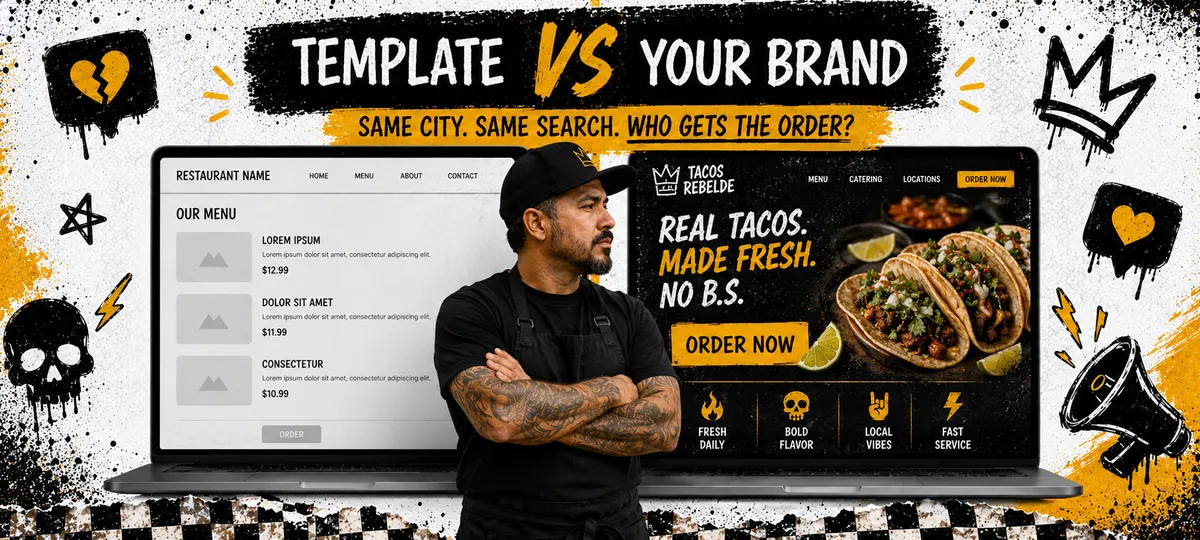
Split-screen showing a generic template website on the left with placeholder text versus a branded Tacos Rebelde custom restaurant website on the right with real food photography and a prominent order button

TL;DR

A custom site is infrastructure, not vanity. Templates share the same layout DNA, bury your menu in PDFs, and lock order data inside their platform. Custom gives you unique SEO signals, full design control, and every email and click on your domain. Already have a site you love? Outbites plugs ordering, loyalty, and SMS in without a rebuild. Starting from zero? Own your domain, shoot real photos, design mobile-first, and put the order button above the fold.

Most restaurant owners start with a template. Squarespace, Wix, a free page bundled with their POS. You can be online by dinner service. That part works. The bill comes due later: every competitor in your zip code starts looking the same in search, your menu lives inside someone else's layout rules, and the phone numbers from online orders sit in a dashboard you do not own.

94%Of first impressions are design-related (Stanford Web Credibility Research)
88%Of online consumers are less likely to return after a bad website experience
3 secMaximum load time before 53% of mobile visitors leave

A custom website is not about spending $10,000 on a developer. It is about owning the digital version of your restaurant the same way you own the physical one. Use the readiness assessment below to see where your current site stands.

Interactive assessment

Website readiness scorecard

Check each item that applies to your current restaurant website. See where you stand and what to fix first.

Your score

0 / 10

Check the items above to see your score

Why Restaurant Website Templates Fall Short

Templates are designed for everyone, which means they are optimized for no one. The layout that works for a yoga studio also powers your restaurant page. That creates three problems that compound over time.

What a Custom Website Actually Gives You

Custom does not mean complicated. It means you decide the structure, the flow, and the priority of every element on the page. Here is what that translates to in practice.
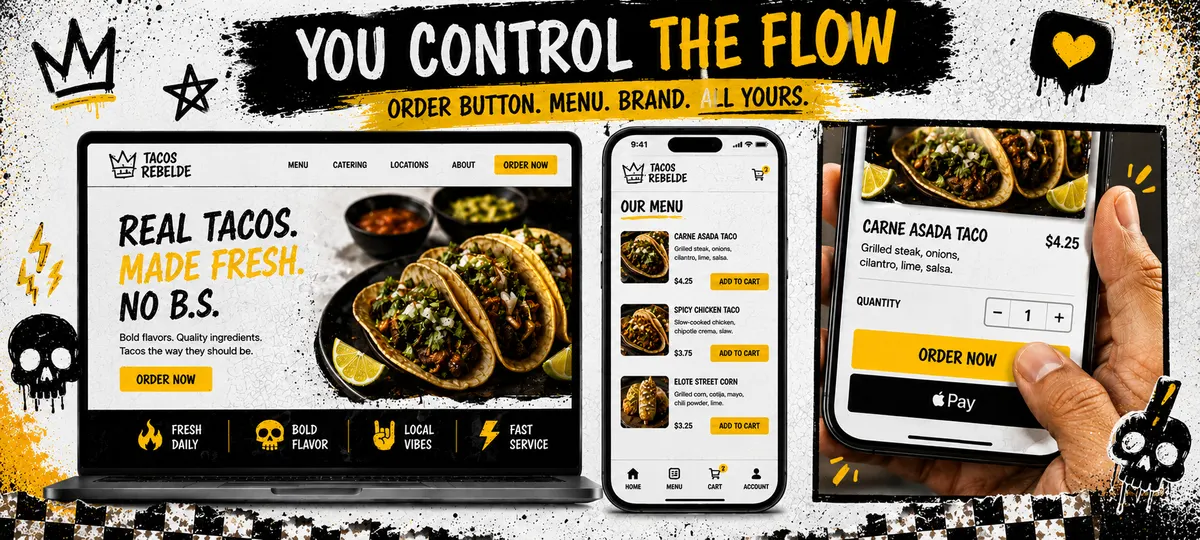
Laptop and phones showing a custom Tacos Rebelde restaurant website with menu, order button, and add-to-cart flow on desktop and mobile
A custom site lets you control exactly what guests see first, what action they take, and how the brand feels at every touchpoint.

Unique SEO positioning

A custom site has unique HTML structure, original content, and page hierarchies designed around your specific keywords. Instead of competing with 50,000 other Squarespace restaurants for the same template signals, you show Google a site that is genuinely different. That matters for local rankings.

Seamless ordering integration

On a custom site, your menu and ordering flow are not iframed in from a third party. They are part of the site itself. Guests do not leave your domain to place an order. The experience feels native, loads faster, and converts better because there is no context switch between browsing and buying.

Full data ownership

Every visitor, every click, every order, every email signup. When you own the domain and the infrastructure, that data is yours permanently. No platform migration wipes your analytics history. No vendor lock-in traps your customer list.

Interactive comparison

Template vs. custom website comparison

Pick a path below. The table spotlights your choice. Tap any row for a side-by-side read on that feature.

Focused feature

Setup cost

Tap a row in the table to compare how each path handles this feature.

FeatureTemplateCustom buildOutbites BYOW
Setup cost$0-50/mo$2,000-10,000$0 (use existing site)
Brand uniquenessLowHighYour design, unchanged
Direct orderingExtra pluginCustom dev neededBuilt-in
Customer data ownershipPlatform keeps itYours (if built right)Always yours
SEO controlLimitedFullFull (your site)
Loyalty + SMS marketingSeparate toolsSeparate toolsIncluded
Ongoing cost$20-80/mo + plugins$5-50/mo hosting$1/fulfilled order

Viewing: Outbites BYOW

Best when you already have a site you love. Keep your design, add ordering and marketing underneath, and pay only when orders complete.

    How to Build a Custom Restaurant Website (Step by Step)

    You do not need to know how to code. You need to know what to prioritize and who to hire (or which tool to use). Here is the sequence that works for most independents.

    1. Get your own domain and hosting

    Your domain is your address on the internet. Buy it separately from your website builder so you always own it. A .com that matches your restaurant name costs $12-15/year. Hosting runs $5-30/month depending on speed needs. This is the one investment you never regret.

    2. Design mobile-first

    Over 75% of restaurant website traffic comes from phones. Design for the small screen first, then expand for desktop. The order button, phone number, and address should all be reachable without scrolling on a phone. If a guest has to pinch-zoom to read your menu, you lose them.

    3. Invest in real photography

    Stock photos of food kill trust instantly. Guests can tell the difference. One afternoon with a photographer (or a phone with good lighting) gives you hero images, menu shots, and team photos that make your site feel real. This is the biggest visual upgrade you can make.
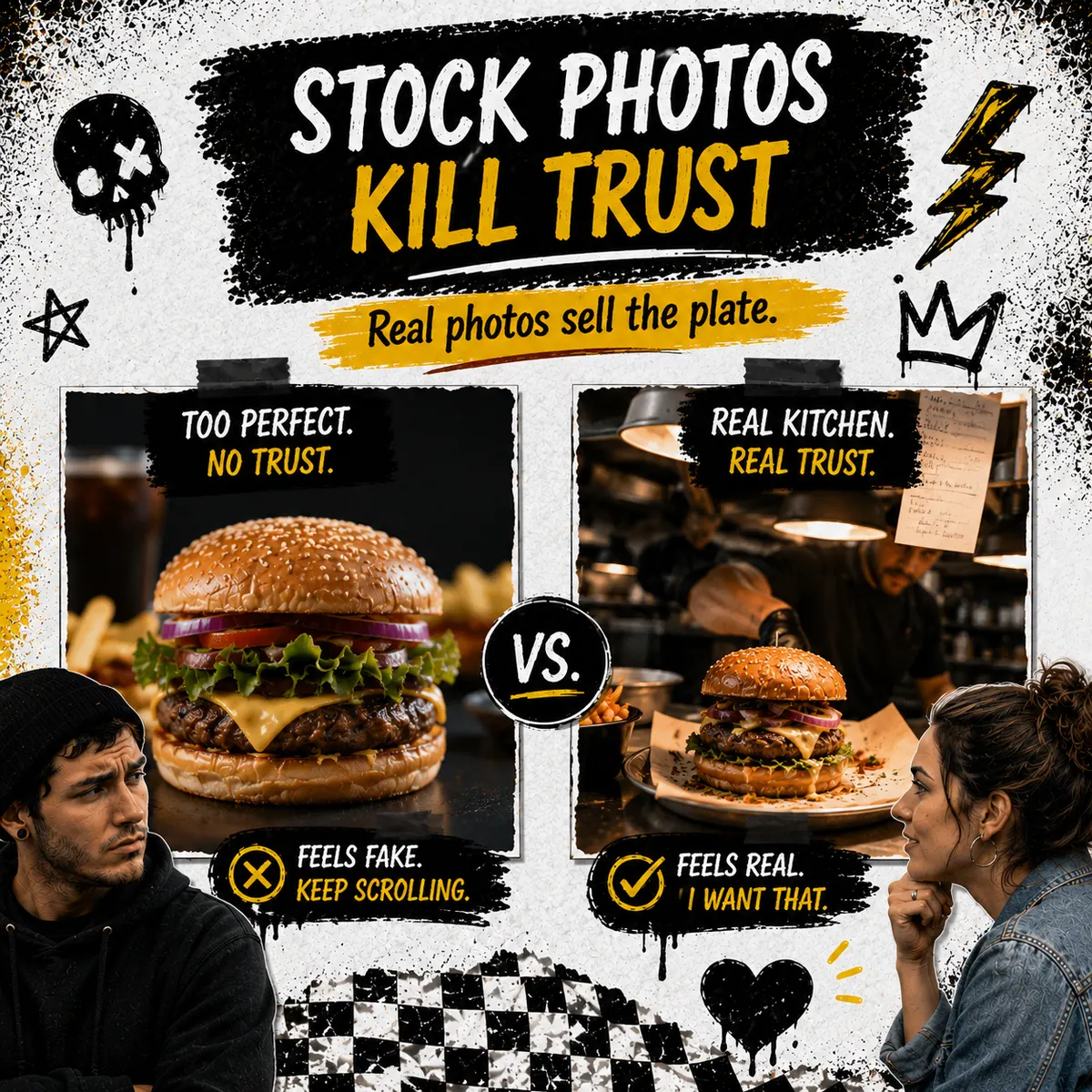
    Side-by-side comparison of a perfect stock burger photo labeled feels fake versus an authentic kitchen burger photo labeled feels real with skeptical and interested guests
    Real photography versus stock: guests notice instantly.

    4. Connect direct ordering

    Your website should be a revenue channel, not just a digital brochure. Integrate ordering so guests can go from landing on your site to placing an order in under 60 seconds. The fewer clicks between "I want food" and "order confirmed," the higher your conversion rate.

    Before you pick a platform or commit to a rebuild, run your real order volume through the calculator below. Year-one stack cost changes fast once you add plugins, hosting, and per-order fees.

    Interactive calculator

    Year-one website stack cost

    Estimate what you spend in year one for a template, a new custom build, or Outbites on your existing site.

    Template stack

    $1,380

    Platform + ordering/loyalty plugins

    Custom build

    $6,300

    Build + hosting + separate tools

    Outbites BYOW

    $1,800

    $1 per fulfilled order, no monthly fee

    At 150 orders/mo, Outbites costs more than a bare template but less than rebuilding. You keep your site and own every contact.

    Already Have a Custom Website? Bring It to Outbites

    If you already invested in a custom site you love, you do not need to rebuild it. Outbites works with your existing website. Embed your ordering link, connect loyalty and marketing tools, and keep the design you already paid for. Your site stays yours. Outbites plugs into it.

    This is different from most platforms that force you onto their hosted site or require you to use their templates. With Outbites, your brand comes first. Add a single ordering link or embed the full menu flow. Either way, customer data, order history, and marketing tools all connect back to your dashboard.
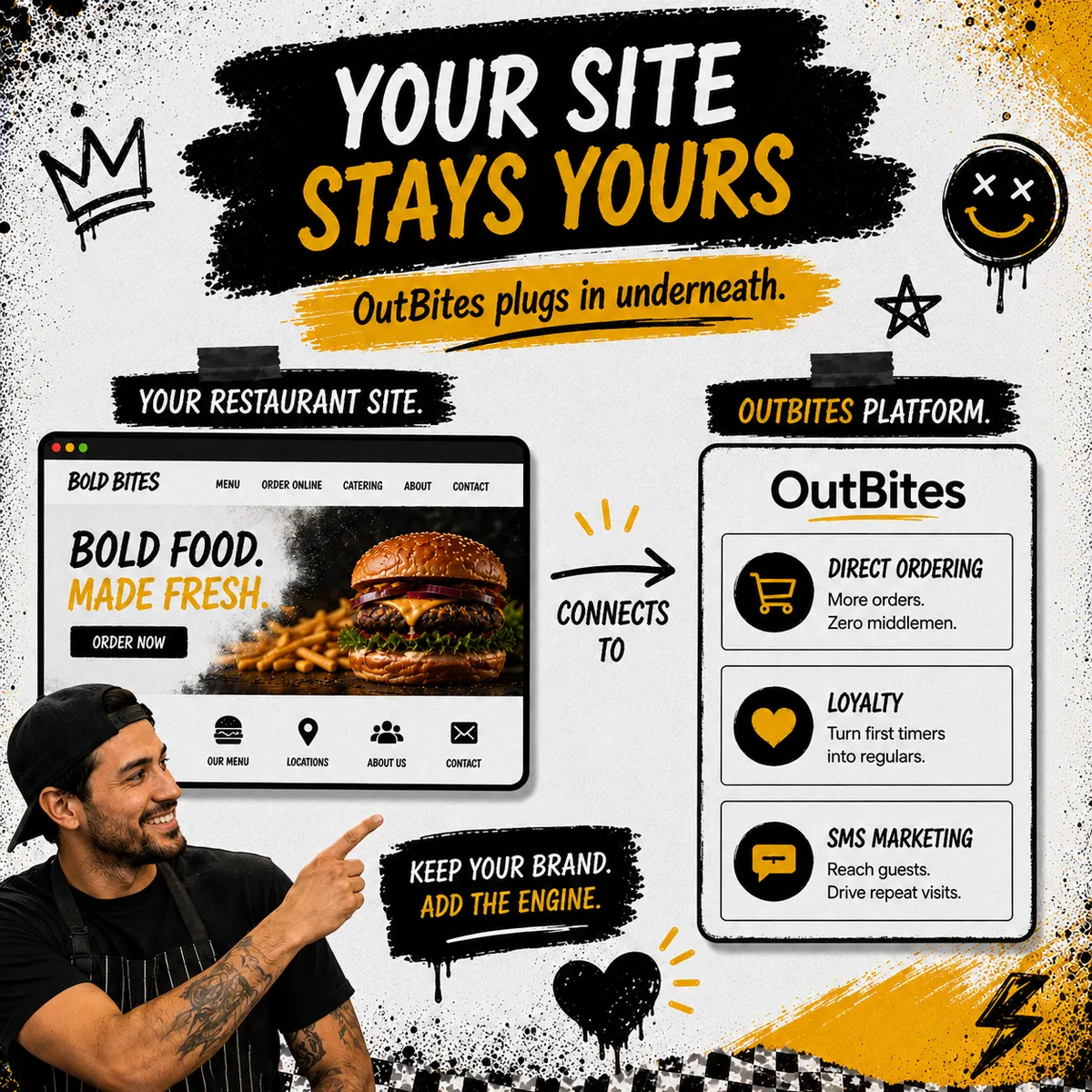
    Diagram showing a custom Bold Bites restaurant website on a laptop connecting to Outbites platform tiles for direct ordering, loyalty, and SMS marketing
    Outbites plugs into your existing site. No rebuild required.

    How bring-your-own-website works

    When to Stay on a Template vs. Go Custom

    Not every restaurant needs a custom site on day one. If you opened last month and have zero online presence, a template gets you indexed by Google faster. But if you have been operating for 6+ months and your website is not driving orders, it is time to upgrade.

    Common questions about custom restaurant websites

    Templates

    Common questions about custom restaurant websites

    1. How much does a custom restaurant website cost? Ranges widely. A freelance developer or agency builds a custom site for $2,000-10,000 depending on complexity. A platform like Webflow or Astro with a designer runs $1,000-4,000. The key is owning the output. If you pay for a custom site, make sure you own the domain, the code, and the hosting account independently. 2. Can I build a custom site myself without coding? Yes. Tools like Webflow, Framer, and Carrd let you build visually without writing code. The result is still custom because you control the layout, structure, and content. The tradeoff is time: expect 20-40 hours for a solid restaurant site if you are learning the tool. 3. What if I already have a website on Squarespace or Wix? You do not have to abandon it overnight. Start by connecting Outbites ordering to your existing site (works with any platform via a link or embed). Then plan the custom migration when your revenue justifies the investment. Many operators run their existing template site with Outbites ordering for months before upgrading the design. 4. Does Outbites replace my website? No. Outbites is not a website builder. It is a direct ordering, marketing, and loyalty platform that plugs into any website you already have. If you do not have a site, Outbites gives you a branded ordering page. But if you have a custom site, Outbites works alongside it.
    Ranges widely. A freelance developer or agency builds a custom site for $2,000-10,000 depending on complexity. A platform like Webflow or Astro with a designer runs $1,000-4,000. The key is owning the output. If you pay for a custom site, make sure you own the domain, the code, and the hosting account independently.
    Yes. Tools like Webflow, Framer, and Carrd let you build visually without writing code. The result is still custom because you control the layout, structure, and content. The tradeoff is time: expect 20-40 hours for a solid restaurant site if you are learning the tool.
    You do not have to abandon it overnight. Start by connecting Outbites ordering to your existing site (works with any platform via a link or embed). Then plan the custom migration when your revenue justifies the investment. Many operators run their existing template site with Outbites ordering for months before upgrading the design.
    No. Outbites is not a website builder. It is a direct ordering, marketing, and loyalty platform that plugs into any website you already have. If you do not have a site, Outbites gives you a branded ordering page. But if you have a custom site, Outbites works alongside it.

    Your website is the only digital real estate you fully own. Social media accounts can get suspended. Marketplace listings can change their algorithm. Google can update its rules. But your domain, your design, and your customer data are yours as long as you want them.

    Outbites works with any custom website. Add direct ordering, loyalty, and marketing tools without rebuilding your site. One dollar per fulfilled order, no monthly fee.

    Start with Outbites

    Tags: custom restaurant website restaurant website builder food truck website design bring your own website restaurant restaurant branding online
    Katie Carswell

    Katie Carswell

    Account & Social Media Manager

    Sharing firsthand stories and lessons learned from running an independent restaurant: margins, marketing, and owning your customer relationships.

    Editorial note Online Discovery Published May 27, 2026

    How this guide was put together

    This article was written for independent food businesses looking for practical ways to grow direct orders, repeat visits, and customer relationships. We keep the advice operator-focused, avoid generic playbooks, and update posts when the restaurant marketing landscape changes.
    Topics covered custom restaurant website restaurant website builder food truck website design bring your own website restaurant

    Continue Reading

    More from the Blog