TL;DR
You are not leaving delivery. You are moving repeats to a lane where you keep more of the check. Week 0: write the one-sentence staff pitch and match your top menu items on your own link. Week 1: put the QR at the window, on the receipt, and in the bio. Week 2: run both channels with one expediter rule and clear pickup labeling. Automate a contact capture at checkout and let signage do the customer conversion so your team does not have to.
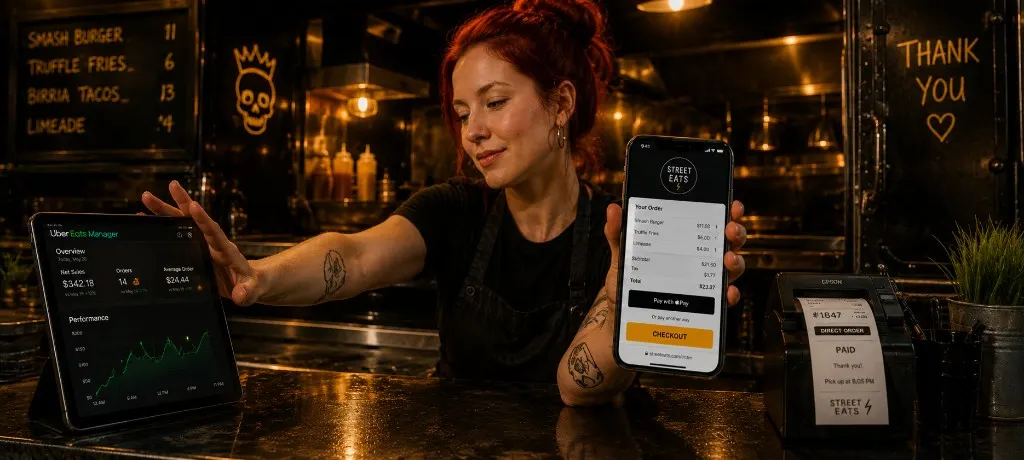
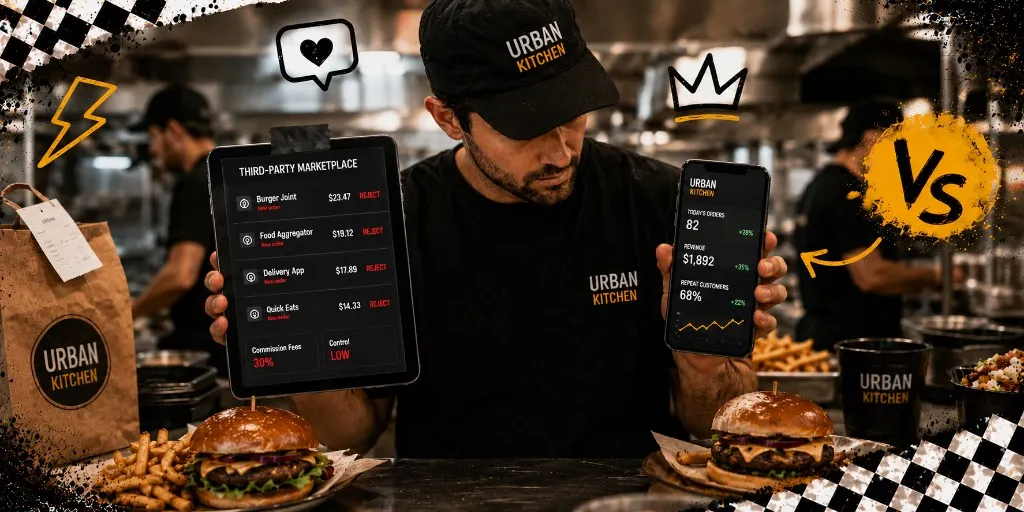
Somewhere between prepping the mise en place and watching the payout land short, most operators do the math. Fifteen to thirty percent on every ticket you cooked, every shift. A food truck pulling $3,500 on a good Saturday is handing $525 to a platform before labor, food cost, or fuel. A ghost kitchen doing $18,000 a month in app orders is writing a check to DoorDash or Grubhub for $2,700 to $5,400. Every month.
The part nobody explains clearly is how to actually make the switch without tanking a week of sales. Pull off the apps too fast and you lose reach before your own link has any traction. Stay too comfortable and the apps collect a fee on every repeat customer who already loves you. The playbook here covers the middle path: keep the apps for discovery and move repeats to a link you own.
Before you change a single sign, run your own numbers. The calculator below uses the same commission bands operators quote in the intro. Slide revenue and rate until the monthly fee matches what you see on your marketplace statements.
If the gap between marketplace cost and a flat per-order model is wide enough to matter, the rest of this playbook is about moving repeat guests without breaking kitchen rhythm.
The Goal Is Not to Delete the Apps
This is worth saying clearly: nobody here is arguing for scorched-earth departures from DoorDash and Uber Eats on a Tuesday night. Apps are still a real acquisition channel. A first-timer who finds you on the map and orders a taco platter is a win. The problem is the second, third, and twentieth order from that same person still funneling through the app, still carrying a fee, with their phone number belonging to the platform instead of you.
The two-lane strategy is simple: stay visible on apps for strangers, route repeat guests through a branded link where you keep the margin, capture the contact, and build the habit. Most operators who do this well see their direct order volume climb steadily over 60–90 days while app volume stays roughly flat. You are not losing reach. You are adding a lane you actually profit from.
Week 0: Before You Touch Any Software
The format you run changes almost everything about how direct ordering lands on customers. Spend 20 minutes in week zero writing one sentence your staff can say naturally at handoff. Not a pitch. Just a clear statement about what ordering direct gets the guest.
Food trucks and pop-ups
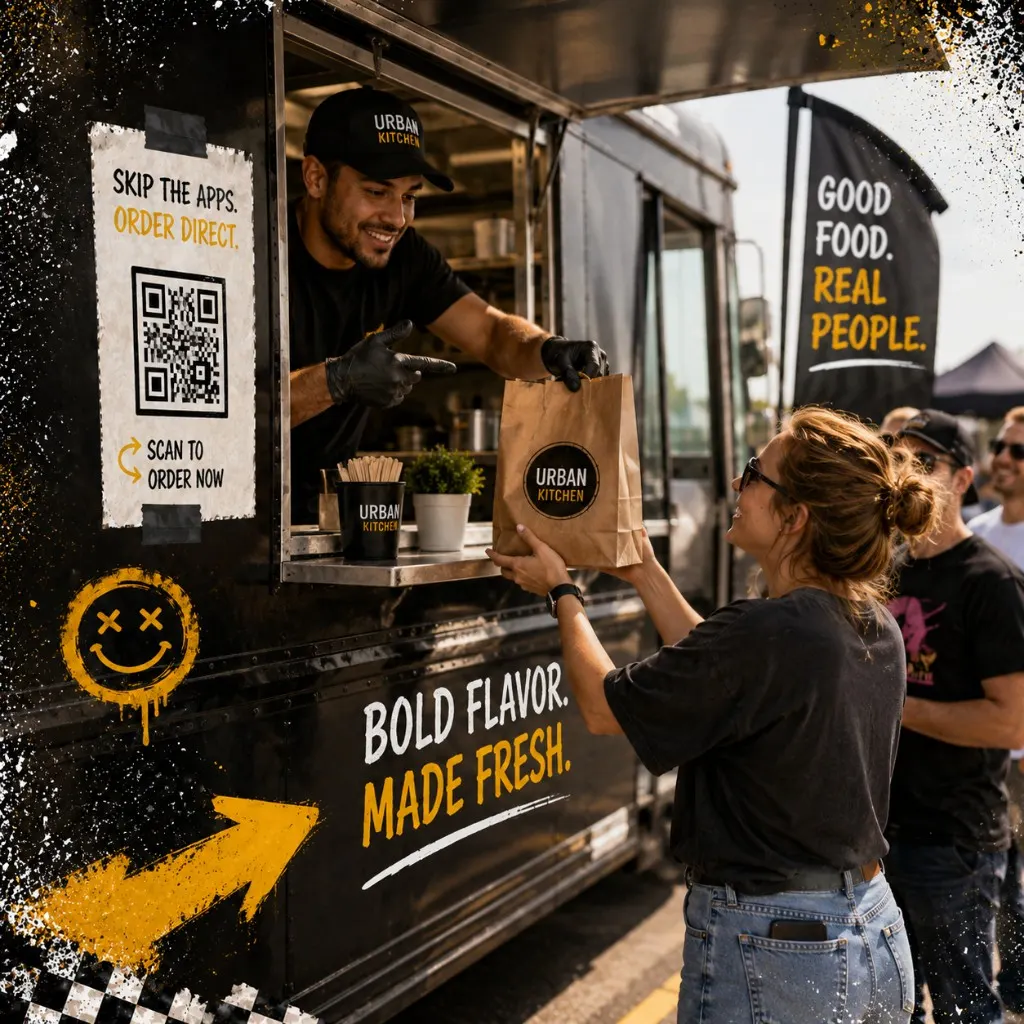
Your guests are standing in a line or a parking lot. Speed is the product. Your direct link needs to answer three things in under ten seconds: what's on today's menu, when it's ready, and where to stand. QR at the window, on the side panel where the line stares while they wait, and on any flyers or social posts. The staff line: "Scan here to order ahead and skip the wait next time."
Ghost kitchens and delivery-only brands
You live on maps and apps. That is fine for acquisition. But your direct link should own the repeat: catering requests, add-ons, and guests who say "same as last time." Your confirmation message needs a pickup door, bag color code, or car line instructions. Apps trained guests to expect tracking-style language. Your SMS can be shorter, but it still has to reduce the anxiety of ordering from a brand with no physical storefront.
Small brick-and-mortar spots
You win on habit change at the door. Table tents, receipt URLs, and one staff prompt at handoff are enough to start. The sentence your host or cashier needs: "If you order on our site next time, pickup windows track the kitchen and we can text you if we sell out." No commission lecture. No tech pitch.
Week 1: Menu Parity Before You Promote Anything
Nothing kills trust in a new ordering channel faster than discovering that a popular combo exists on DoorDash but not on your own link. Guests don't give you a second chance when they hit that wall mid-order.
- Mirror your top movers first, not the whole menu. Start with what 80% of tickets include. Add depth after the channel earns trust.
- Match modifiers and 86 behavior across channels. If an item dies mid-service on the app, it should vanish on your link just as fast. Modifier drift is where errors multiply and bad reviews start.
- Pick one pricing story and own it on signage. Some operators keep app and direct prices identical. Others price slightly lower on direct. Whatever you choose, put it plainly in the menu description so nobody feels tricked when they compare screens.
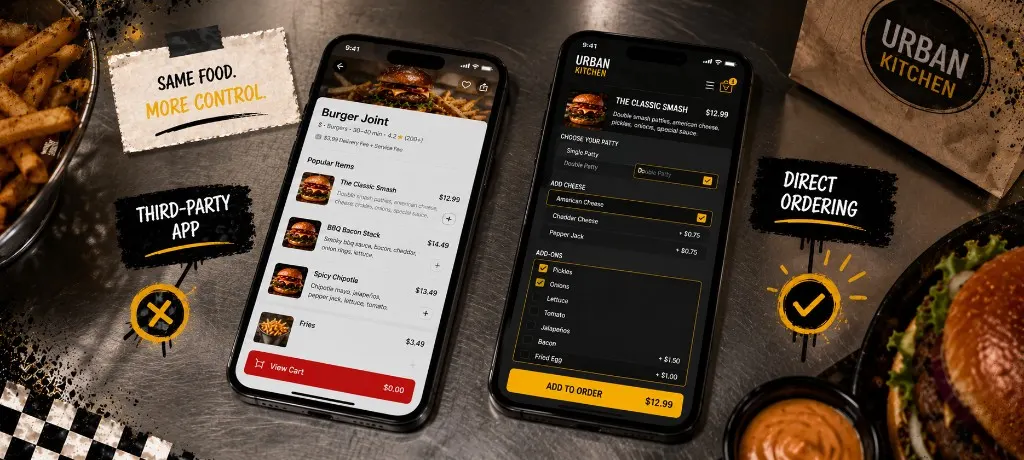
Menu parity is the trust layer. Dual-run is the stress test. Week two is when both channels hit the same pass at the same time.
Week 2: Dual-Run Without Double Chaos
Running your direct link alongside marketplace tablets during the first weeks is not about having two systems forever. It's about proving the channel works before you make any moves to reduce app volume. The kitchen should not feel like it is suddenly managing two separate restaurants.
- One expediter owns the fire order. When two channels spike at the same time, one person decides which ticket goes first. Write down who that is and what the rule is. "Whoever is next in queue, regardless of channel" is a perfectly fine rule. Unwritten rules break under pressure.
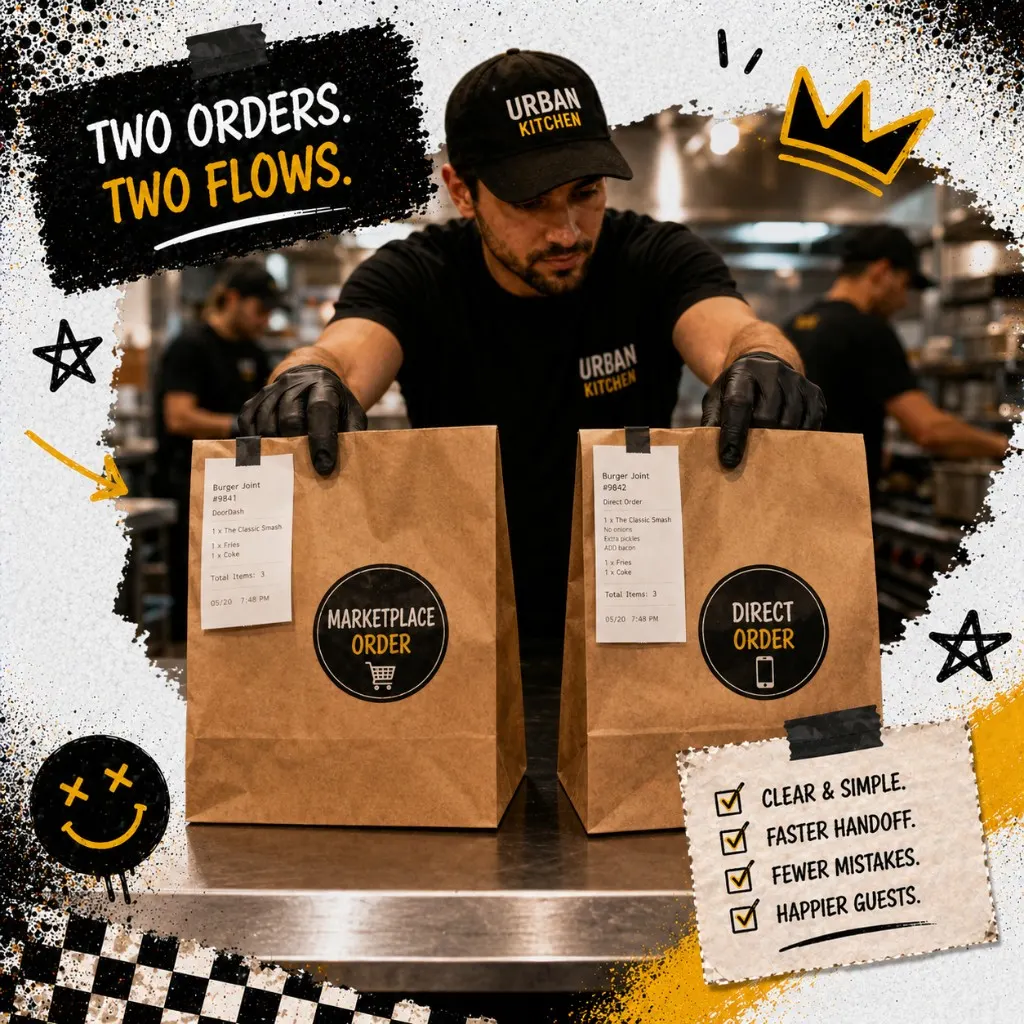
- Label direct orders visibly on the bag or ticket. If a runner picks up a bag and cannot tell in half a second whether it's a marketplace order or a direct order, your labeling is not clear enough. A sticker color, a printed tag, or a separate column on the ticket printer all work.
- Quote pickup times you can actually beat. If your direct link promises 15 minutes and you're consistently running 22, fix the time before anything else. Breaking a pickup promise on the first direct order is the fastest way to send someone back to the app permanently.
Same dish, two paths. Step through the journey below for one guest order on a marketplace app versus the same order on your direct link. The difference is contact ownership and payout, not just ticket formatting.
The Customer Migration Script That Actually Works
Guests do not follow you to direct ordering because of your margin math. They follow because the experience is clearly easier or better for them. Keep that in mind before you write any signage.
Use the copy blocks below at the window, on receipts, in your bio, and once at handoff. Replace the bracketed fields, tap copy, and paste where your guests already look.
Train staff to ask once at handoff. No lecture about platform fees. No pressure. The guests who care about supporting you directly will scan. The guests who don't will keep ordering on the app, and that's fine too. The goal is that your regulars have the option.
Promos That Move Behavior (Without Buying Discount Shoppers)
One incentive for the first direct order. Then get back to normal pricing fast enough that you have not trained anyone to wait for the next coupon before ordering again.
- Loyalty credit on first order. A small reward toward visit two. Ties the incentive to returning, not just trying the channel once.
- Early drop access for trucks and pop-ups. First to order on the direct link gets the sold-out special before the line forms. High perceived value, zero margin cost.
- Family or group bundle on direct only. A combo that is easier to build and describe on your own checkout than inside an app card. The value is clarity and portion size, not a discount.
- Prepaid priority for ghost kitchens. Prepaid direct orders get priority bag placement at the shelf. No coupon code required. Just an operational truth that is worth communicating.
What Breaks First (So You Are Not Surprised)
Every dual-run launch has the same four failure modes. Knowing them before you start is the difference between a fixable Tuesday and a bad review that outlives the problem.
- Modifier mismatch between channels. Fix it in the menu build. Spend 30 minutes cross-referencing your app menu and direct menu side by side before anything goes live.
- Pickup times that assume a full crew. Build your direct lead time with a one-person buffer. It is better to beat your promise than to break it on a short-staffed Wednesday.
- Refunds across two systems. Write one rule on a notecard at dispatch: who handles it, which system gets the credit, how it is logged. Improvised refund policies create receipt discrepancies and avoidable staff arguments.
- Guests who never save the link. Signage and one SMS to past opt-ins will move more people than any single Instagram post. The guests who already know you are the ones most likely to follow.
Google Visibility While You Make the Switch
One move worth making in week one: update your Google Business Profile ordering link to point at your direct checkout. Guests who find you on Maps are already high-intent. Give them a path that skips the app entirely. While you're in there, confirm your hours and photos are current. A stale profile during a channel transition is a visibility gap you do not need. The 30-minute weekly routine covers this GBP audit in about eight minutes. Then watch the shift in your restaurant reporting dashboard: direct orders, marketplace mix, repeat rate, and average ticket should start moving before total sales looks dramatic.
Once your direct checkout is capturing guest contacts, you also have a path to automate review requests 90 minutes after each order completes. That review velocity compounds your local search rankings over time and makes the direct channel pay dividends beyond just margin.
Direct ordering launch
Switching Checklist: Weeks 0–2 (print-friendly)
Work through this before your first promo. Most of the gaps that sink a channel launch are on this list.
- Write your one-sentence staff pitch before opening any software.
- Mirror your top 80% of menu items on your direct link with matching modifiers.
- Test your own link: LTE, incognito, time from scan to order confirmation.
- Set pickup times with a one-person buffer. Under-promise, over-deliver.
- Place QR at the window, side panel or counter, and on the receipt or bag.
- Update your Google Business Profile ordering link to point at your direct checkout.
- Decide your pricing story and state it plainly in your menu description.
- Write the refund rule on a notecard and put it near dispatch.
- Set one first-order incentive. Pick an end date so you exit the promo cleanly.
- Run both channels for 2 weeks. Track: direct order count, repeat rate, avg ticket vs marketplace.
- Send one SMS or email to past opt-ins with your direct link after week one.
- Schedule a win-back campaign for any direct guests who have not returned in 30 days.
Tip from the floor: give this checklist to a shift lead, not just the owner. If it only lives in one person's head, it will not survive a busy week.
You are not leaving delivery. You are adding a lane where the same guest pays you full margin, gives you their phone number, and builds a habit that does not depend on a platform's algorithm deciding how often your name shows up in someone's feed.
The shift from QR menus to integrated ordering already happened in most markets. Guests who found you on an app are primed to order on their phone. They just need one clear reason to bookmark your link instead of reopening the app next time.
Templates
Common questions about switching to direct ordering
Ready to set up direct ordering?
Outbites gives food trucks, ghost kitchens, and independent restaurants a branded checkout link, Stripe or Square payment, and built-in contact capture. Fifteen minutes to set up. One dollar per fulfilled order.
Start with Outbites
Katie Carswell
Account & Social Media Manager
Sharing firsthand stories and lessons learned from running an independent restaurant: margins, marketing, and owning your customer relationships.
How this guide was put together
This article was written for independent food businesses looking for practical ways to grow direct orders, repeat visits, and customer relationships. We keep the advice operator-focused, avoid generic playbooks, and update posts when the restaurant marketing landscape changes.