TL;DR
You do not need more customers to grow revenue. You need bigger tickets from the customers you already have. Configure one combo prompt per entree, one add-on suggestion after cart, and a free-delivery threshold $3-5 above your current average. Limit to one prompt per transaction. Measure take rate weekly and kill anything below 8%. A $4 bump on 200 weekly orders is $800 more per week, $38,400 more per year. Same hours, same staff, same menu.
You already have customers. They are already ordering. The fastest path to more revenue is not another Instagram ad or a new menu item. It is getting each existing order $4 to $8 higher. That math compounds fast, and the margin on add-ons is almost pure profit because your fixed costs are already covered.
Slide the numbers below and see what a small per-order bump does to your monthly top line. Most operators underestimate this because they think in single-ticket terms.
Why Average Order Value Matters More Than New Customers
Acquiring a new customer costs 5 to 7 times more than selling something extra to someone already checking out. A food truck spending $8 on an Instagram ad to get one new $14 order is making less than the truck that adds a $3.50 side to 40% of existing tickets with a single checkout prompt.
AOV gains also stack on top of every other growth lever. When you grow your customer list and send campaigns, those campaigns drive higher-value orders. When you move orders off DoorDash, you keep more of each bigger ticket. The compounding is real.
The Math on a $4 Ticket Bump (It Compounds Fast)
Take a food truck doing 200 orders per week at an average of $14. That is $2,800 weekly. Add $4 per order and you are at $3,600. That is $800 more per week, $3,200 more per month, $38,400 more per year. Same number of customers. Same hours. Same staff.
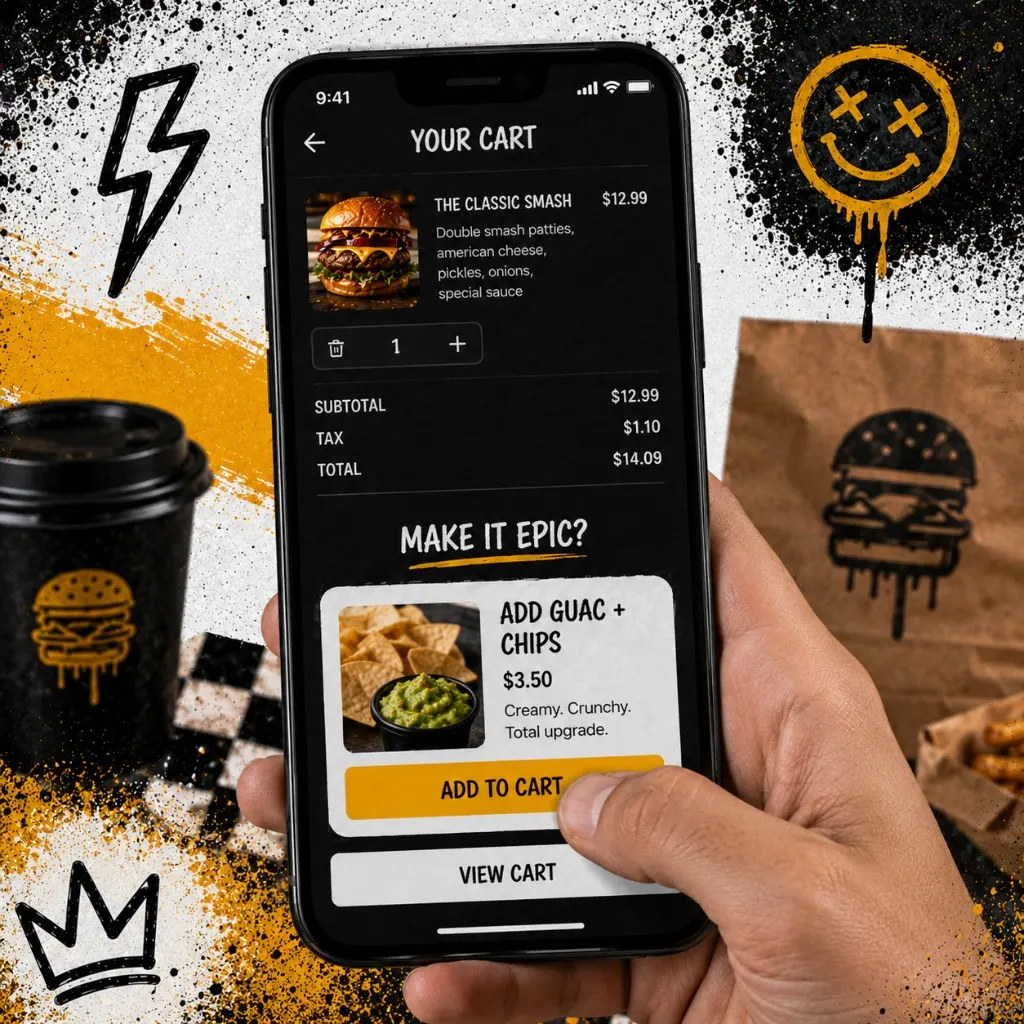
The margin on that $4 is better than any discount campaign you will ever run. A side of chips costs $0.60 to make and sells for $3.50 as an add-on. A size upgrade costs pennies in extra protein but adds $2 to the ticket. This is not a growth hack. It is how chains have operated for decades. Independents leave it on the table because their ordering system never prompts it.
Five Upsell Tactics That Work on Digital Orders
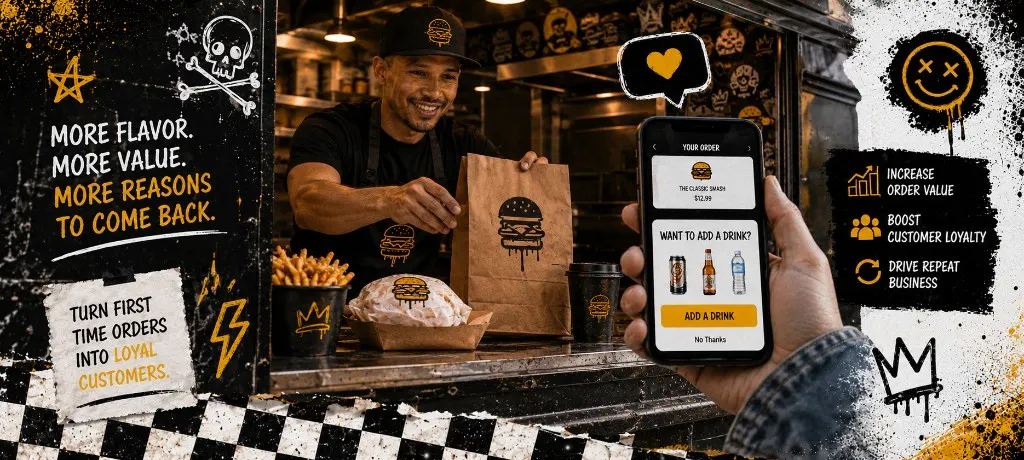
Digital ordering removes the awkwardness of verbal upsells. Nobody is standing at a counter feeling pressured. A well-designed prompt feels like a helpful suggestion, not a sales pitch. Here are the five that consistently move the needle.
1. Combo logic at checkout
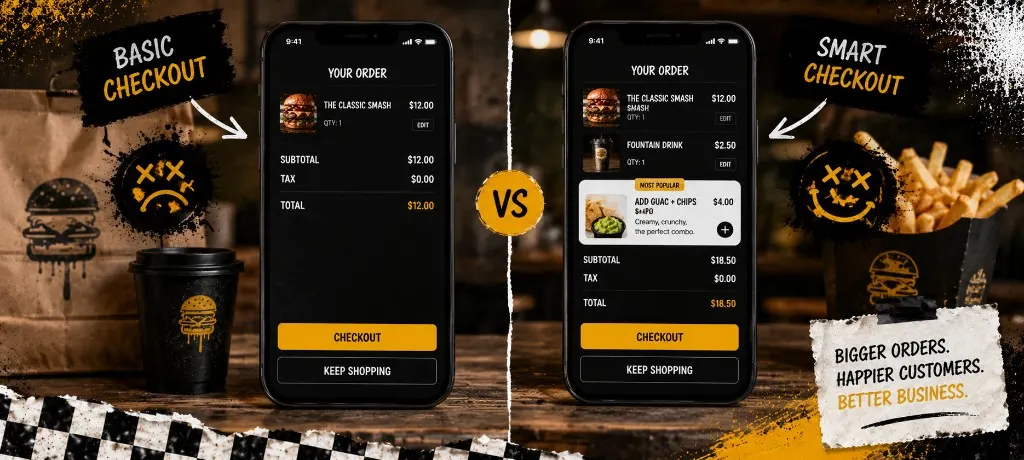
If a guest adds an entree, show a combo option that bundles a side and drink at a visible discount. The key word is visible. "Save $2.50 with the combo" converts better than just listing the combo price. The guest needs to see the math without doing it themselves.
2. Smart add-on prompts after cart
Trigger one (not three) add-on suggestion after the guest finishes building their cart. Base it on what is already in the order. Taco order? Show chips and salsa. Bowl order? Show a drink. The relevance is what makes it work. Generic "add a cookie" prompts perform half as well as contextual ones.
3. Modifier upgrades (size, protein, premium sides)
Default to regular. Offer large. Frame it as "make it a large for $2 more" instead of listing both sizes and hoping they pick the expensive one. This is the "Would you like to supersize that?" of independent restaurants, except it happens silently on screen.
4. Minimum-for-free-delivery thresholds
Set your free delivery minimum $3 to $5 above your current average ticket. If average orders are $16, make free delivery kick in at $20. Show a progress bar: "Add $4 more for free delivery." Guests will add items to cross the line. They feel smart, not upsold.
5. Limited-time bundle pricing
A weekend-only bundle at a fixed price ("Friday Night Combo: 2 entrees + 2 sides + 2 drinks for $38") creates urgency and locks in a high ticket. Rotate it weekly. Measure take rate. Kill anything under 8% and replace it.
When Upselling Backfires (And How to Avoid It)
Bad upsells erode trust faster than they grow revenue. Three rules to stay on the right side:
- One prompt per transaction, max. Stacking three suggestions feels desperate. Pick the highest-margin one and show it once. If they dismiss it, done.
- Never upsell after payment. Post-payment screens that say "add dessert?" cause abandoned carts and refund requests. The moment is before the total, not after.
- Match the price tier. Do not suggest a $12 appetizer to a guest ordering a $9 bowl. The add-on should be 20-35% of the cart total or below.
Test in small batches. Run a new prompt for 50 orders and check acceptance rate before rolling it out. If fewer than 8% of guests tap it, the suggestion is wrong, not the strategy.
Setting Up Upsells in Your Ordering System
Most ordering platforms support add-on prompts, but few operators configure them well. Here is the setup that works across food trucks, ghost kitchens, and counter-service restaurants:
- Map your menu into tiers. Entrees, sides, drinks, desserts. Every add-on prompt should pull from the next-lowest tier relative to the cart.
- Set one default combo per entree. Pick the highest-margin pairing and make it the first thing guests see after adding that item.
- Configure your free-delivery threshold. Pull your last 30 days of average order data. Set the threshold $3-5 above that number.
- Enable modifier upgrades. For items with sizes, default to regular and offer the upgrade inline. For proteins, offer the premium swap.
- Schedule limited bundles. Pick one slow night per week. Build a bundle. Promote it via SMS at 2pm that day.
With Outbites, smart upsells are built into checkout. You pick the pairings, set the discount, and the system shows the right prompt at the right moment. No code required.

Measuring What Actually Moved the Needle
Do not guess. Track these three numbers weekly:
- Average order value: Total revenue divided by total orders. Compare week-over-week.
- Upsell take rate: Percentage of orders that accepted an add-on or combo. Target 15-25%.
- Items per order: If AOV climbs but items per order stays flat, your price increases are working. If items per order climbs, your prompts are working. Both is ideal.
Review every Monday. Kill underperforming prompts fast. Double down on what converts. A food truck running 4 rotating combos per month and keeping the winner learns faster than one running the same stale suggestion for 6 months.
Use the tracker below to compare two prompts side by side. Enter orders shown and orders accepted for each version, and it will tell you which one to keep and which to kill.
Templates
Common questions about restaurant upselling
Upselling is not about pressure. It is about showing guests options they already want but would not have thought to add. One prompt, one tap, and a ticket that covers more of your fixed costs every single order.
Ready to grow your average ticket?
Outbites includes smart upsells, combo prompts, and checkout add-ons built into every branded ordering link. Set up pairings in minutes. One dollar per fulfilled order, no monthly fee.
Start with Outbites
Katie Carswell
Account & Social Media Manager
Sharing firsthand stories and lessons learned from running an independent restaurant: margins, marketing, and owning your customer relationships.
How this guide was put together
This article was written for independent food businesses looking for practical ways to grow direct orders, repeat visits, and customer relationships. We keep the advice operator-focused, avoid generic playbooks, and update posts when the restaurant marketing landscape changes.